Richardson book website
  • Tributary
  • Guest House
  • About
  • Blog
Save the Last Dance for Tree 01/19/2012
1 Comment
 
_ Hundred-mile-an-hour wind gusts are fairly common in Boulder, Colorado, at least since I moved here. The gusts last night started around dark and walloped our cul-de-sac without mercy until noon today.

Picture


I slept approximately not at all.

The house shook,
the windows howled,
the fireplace flue played
the pan flute all night long.


_ This morning around five thirty I heard a little tap, a dainty scrape outside.
When I walked out my door at eight thirty, I saw this--
Picture
_ being held up by this--
Picture
_ engulfing both cars like this--
Picture
_ as nearly 8,000 pounds of pine tree blocked our driveway.
Picture
_ The arborist from Blue River Tree Care was already on the scene. He called in the largest crane that I have ever seen (and I’ve installed landscapes for 14 years)
Picture
Picture

which dropped a daredevil
down into the crown of the tree
who chopped two branches out
with a hand saw, attached the cables

and while we gaped from the upstairs landing window

that two-story pine tree


Picture
Picture
_ danced like a baby ballerina up over our heads
Picture
_ and touched down in point, where the crew promptly undressed her.
Picture
_ This miracle surpassed the miraculous activity indoors: my final day polishing
the last draft of my novel Tributary, 19.6 years in the making. Sharing the very last hours on this my magnum opus with the flight of the bumblebee pine tree--
Picture


I may have to take up the pan flute.
And play it hiking in the pines.


(For those of you smitten with pan flute fever . . .
Picture
check out this crazy website!)
1 Comment
 
Plunge 07/31/2011
0 Comments
 
Picture
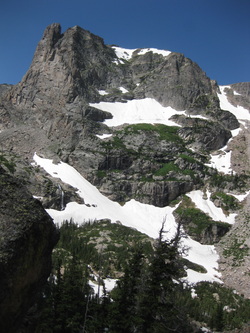
Hiking in Rocky Mountain National Park yesterday, I sang—heaven help me—“Rocky Mountain High." I pondered a Henry James novella I’d just read, “The Beast in the Jungle.” Because I wore brown-tinted sunglasses, the beetle-kill pines stood out on every slope, and I could not feel anything but implicated in and convinced of our changed planet.

In James’ story, the hero John Marcher misses the event of his lifetime. He feels chosen by an obscure destiny, waiting as if anointed for some beast to leap onto him and render his life profound. May Bartram, the only friend who knows of his obsession, stands beside him for decades, waiting, but Marcher’s self-absorption is so complete he only realizes when flinging himself on May’s grave that he has missed out on her love. That was his unrecognized beast.

The twists and turns of James’ syntax far exceed plot points, and I dismissed “The Beast in the Jungle” as a windy staid study in the human ego; profound—the beast is within not without us—and a dated sleeper written by a man who spent all his time indoors.

But as I hiked the thousand feet up toward Lake Helene, surrounded by vast browning slopes, the power of his novella came at me from an unexpected quarter, haunting my climb. James’ protagonist fit perfectly our environmental dilemma: we cannot really love the earth, though it offers itself, so we use it and simultaneously feel cut off from it, valuing our self-importance more than the opportunity to genuinely live, which makes us unable to stop pillaging, unable to stop missing the point, and we're just about to throw ourselves on its grave in misery and cowardice, like James' hero. Empty, when what is offered us is so full.

I have found no good way to face such a grand-scale environmental demise. Which leaves me in the Jungle with John Marcher.

Whatever you can do to plunge into this love, do it now.
Add Comment
 
The Mormon Moment 06/12/2011
0 Comments
 
You can't keep a good thing down.
Picture


It's nature's way. This tree, having endured heaven knows what death-dealing impact, sprang to life this spring, as trembly green and fragrant as all its compadres on the creek trail by the peacock farm at Greenbelt Meadows, near my home.

Ah, greenbelt. Ah, meadows. Ah, forming oneself around and with and through the blows dealt in the course of growing up. That is why I love trees: they don't mask their injuries, they capitalize on them, when they can.


My novel Tributary, the one that took twelve years and nearly a hundred drafts to complete, the one based on my Mormon pioneer ancestors, the one that's been sitting in a closet for six years recovering from the blow of non-interest by the publishing world, just sent trembly green and fragrant leaves out to dapple my trail. It has a publisher. Torrey House Press will print Tributary by Christmas.

Which makes me mighty glad.
Picture
Newsweek says this is The Mormon Moment. The Mormon Moment apparently extends to the literary world, as well. Stay tuned, as I'll be updating my website this summer—with photos and excerpts and such from Tributary—in preparation for the holiday launch.
Picture


Take heart. If you live through the heart-stopping difficulties, they can form and strengthen and even liberate you.

Life needs your sap, your dappling of the path, your instincts, your particular expression of this momentary joy.


Add Comment
 
The Locking Tree 09/24/2010
1 Comment
 
Picture
This week, I discovered a painter who loves trees. I am always looking for artists who love trees. Her imagination ravishes trees.
Picture
She painted without schooling.

A fine French director made a movie of her life: Seraphine. It won Yolande Moreau a Best Actress award in France, and won seventeen awards worldwide in 2009. It’s a quiet, unflinching film that gets your hands dirty.
Picture
Divinely dirty. Soil is divine.

Picture
"Where has the tree gone, that locked earth to the sky?" Philip Larkin asks in his poem "Going." The tree is here.
Picture


Seraphine of Senlis and Emily Carr and Georgia O’Keefe. These three followed their inner directives to worship the living earth with paint. How do you worship?


Picture
"Can you understand the light among the trees?" Nick Drake asks in "The Way to Blue." Seraphine Louis did.
1 Comment
 
Super-Golden Years 09/12/2010
0 Comments
 
Picture
My mother just turned 92 years old. Two things strike me about her super-golden years. Her forgetfulness has made her past a happy one. And her new-found love of trees and birds makes my own enthusiasm look modest. 

Last week as we drove home from her hairdo appointment, down a shady tree-lined street, my mother said, “I just can’t understand what would make any two people divorce. Why would they do that?” Sometimes I let her wacky statements go with a nod and a smile. But I’d lived in our household; I could not let that pass without a reality check. I said, “You divorced Dad!” My mother said, mildly, “I never did.” I said, “You kicked him out of the house my freshman year of college. Divorce came later.” She didn’t protest or say a word. She had completely forgotten his indiscretions, her years of isolated grieving.

For her, marriage produced five great children and provided adventure (as an Air Force wife, she lived 19 places in 25 years). She had flown the Utah coop. She’d lived in Japan. She played golf on more courses than Campbell’s has soups. And now she has forgotten the strains and agonies that accompanied that journey. You may not like tapioca but it has a pleasing flavor on my mother’s tongue.


As for trees: my mother used to vacuum her patio Astroturf, cursing the box elder trees that dared to send their seed pods down into her seven square feet of the great outdoors. Her hatred of trees was so pronounced, I often had to excuse myself from the room. I’m a landscape designer. Trees are the answer, in my book. The only thing that kept me sane as a teenager in Davis County, Utah was escaping to the mountains, following deer paths through the scrub oak, jumping off sandy cliffs with tree-root tendrils flying overhead, shooting the tube in old irrigation culverts among tree canopy and dirt ravines.


Now, trees are my mother’s dearest friends.


When we moved her out of her condo into assisted living two years back, I made sure that her window had a view. She loves looking out on the world. And this particular view is a Utah treasure. Mount Olympus defines the skyline, and her parking lot is ringed with maples, pear and apple trees, sycamore, box elder and ailanthus/trees of heaven. I thought she would enjoy watching the comings and goings of the staff and visitors. But my mother stands bewitched by the moods of the wind in those trees. She reports on their bird visitors. She laughs like she has the scoop on intimate friends.


Picture
After her morning exercise class, my mother takes her cane and walks the perimeter of the parking lot. Sometimes twice a day. And when you visit and join her on those walks, she makes sure you stop and notice every tree, the color of their leaves, what they drop, how they’ve been chopped for the power lines to go through, which and how many birds perched in the tops and “had a conversation” before moving on.

These walks are nothing short of miraculous, for me—to hear this old heathen tree-hater stand in awe of her family riches. And that’s what makes me admire and love my mother. She has changed. She allows delight in. She seeks delight where there was anger and boredom and judgment. And if she recreates her past by siding with the joyful and calm and beautiful, well that’s an affliction I hope many of us encounter with age. The world could forget plenty of its grudges. And walking with my mother, it seems our primary job on earth is to remember the overwhelming bounty of its joys.

Thanks to Exploring the World of Trees for the photo of sycamore seed pods.
Go to What Tree Is It? to identify trees you encounter, by leaf shape, fruit or name.


Add Comment
 
Sumi Nagashi 09/04/2010
1 Comment
 
Picture
What a simple tree-buying expedition can reveal! My sweetheart and I drove a bunch of hot dry miles to Copperton, on Friday, to pick out a Japanese Maple to flank our front porch. We hopped into the golf buggy provided by the wholesale nursery, and drove to the J. Maple section. No Home Depot maple mutt for us, we’d decided to treat ourselves to a genuinely lovely tree.

All of the trees on hand looked picked over, stunned and stunted with September heat, all but one grouping. It was a type of Japanese Maple we’d never seen before: Sumi Nagashi. Yes, they were expensive with large root balls in twenty-gallon containers. And beautifully pruned, with just the multi-trunk bodies we’d envisioned for our tree. Some local designer who used them with delight had ordered them in, and then the economy trembled.

Picture
We circled the Sumi specimens, all with outward-arching branches so slender they suggested bamboo. Airy leaves. Promise of great red color in spring. One tree in particular stopped our discouraged rummaging. Any tree that can sit on a wind-swept graveled desert floor when it’s ninety-four degrees in September and look fresh as Betty Grabel—well, our choice was made for us.

At home, I looked up Sumi Nagashi on Google. Lo and behold, the tree gets its name from the delicate art of Japanese paper marbling. Translated literally, Sumi Nagashi means "floating ink." You’ve heard of Sumi-e ink? Well, swirl colored ink in water and lay paper onto the patterns you create, and you have Sumi Nagashi. (I may have left out a few details and centuries of mastery!) The Japanese art of paper marbling is the oldest on the planet. I remember admiring books from Japan with marbled paper when I was a kid. We owned a few. I took one to "show and tell" in third grade. The fascination was strong then as now.


Picture
Picture
Picture
Picture


The naming of our tree after this art bodes well for us next spring! The delicacy we intuited in the young tree we chose won’t just fill a blank space in our garden. It will magnetize energy. Announce and welcome the beauty of the natural world. Which is the world that we all love, know it or not. Honor it or not. Admit it into our deepest knowing or forget our generous birthright.

Trees are a form of love that beggars words. And still we try.


Special thanks to The Garden at honeybrook house cottage for the lovely tree photo!


1 Comment
 
The Mistaken World 07/07/2010
1 Comment
 
Picture
On May 24, tree limbs all over my neighborhood were in real trouble. They hovered at eye-level, weighted with snow from a freak spring storm. That late in May, the street trees had leafed out full, and the wet weight of snow had disfigured linden, ash and the maple tree in my front yard. Two torn limbs blocked the sidewalk, wedged downward like open hands. I pushed and pulled—they were too tall for me to drag out of the way. I would have to cut the network of branches in order to clear a path.

Let me tell you about the danger of the Mistaken World.

I have two women living inside of me. One is young and sprightly, competent and eager; she flies about fixing, creating, solving and doing for others. Once in motion, the Project Manager finds it nearly impossible to stop. Exhaustion stops her. Felled limbs under heavy unexpected snow. She feels torn and confused by the destruction that comes, every time, as a result of too much work, too much speed. Her body breaks down, her emotions follow. Hers is a Mistaken World. The world we make and read about in newspapers every morning. This is not the natural world. It is a manufactured freak snowstorm of activity we mistake, every day, for reality.

We may not recognize this world as mistaken, having rarely stepped outside of it.

The other woman in me lives quietly, a modest older sister who notes the beauty in limbs, green or bare, aloft or downed. I call her the Oldtimer. She is drawn into activity by what is around her, knowing that her main job, her heart job is to appreciate. She lives in the center. She waits to be led. She is not fooled by fury—furious accomplishment, furious acquisition, furious judgment, division, rejection or need. She smiles when her eyes open on May 24 to snow falling into her green maple tree. She sees the overweighting all down the street. She hopes for the least disfigurement of these grand shade trees.

Then she gets out her hand saw to clear a path.

We choose to inhabit the Mistaken World until it inhabits us. We’re blinded to our own very direct access to wisdom. We look to others, to churches, to Wall Street, to Google and e-zines. We accept the overweighting—as if human industry excused every stupidity, every wound inflicted, every lost limb. Mistakes en masse create misery. We all feel it. We fear and worry over it. We even despair there’s little we can do. Recognizing the Mistaken World might seem to take us far in righting the wrong, but analyzing a problem usually increases the trance it holds over us. Would you stare down an angry rattler until it told you how to escape?

It is simpler and far more effective to ask how do we recognize the real world?

I can suggest ways, but only you will know how to get real:

Slow down.

Contact your heart.

Be grateful, and patient, so that what comes to you is enough.

Let everything around you speak its piece.

Listen.

Let slights move through you.

Stand up for beauty.

Sit down and wait.

Welcome the unknown.
Get old, whatever your age, get calm, get simple. Pay attention, Oldtimer. You are in this world to appreciate it. Appreciation is our native human state. 
Clear the decks for delight. Ask and you will receive.

Let’s get started.


1 Comment
 
The Art of Going Dormant 12/18/2009
0 Comments
 
Picture
What if you could spend an entire day doing nothing but appreciating your whole life? Take a wintry walk and ask trees how they do it.

Trees aren’t stupid. They hold their places all winter long using
fewer resources. Dormancy is an art many of us have forgotten.
“To everything there is a season” and the winter season bodes rest.

Despite lost limbs, occasional drought, low light, crowding, windstorms, beetles, blight, and all other hindrances to growth, trees individuate beautifully. Let yourself draw from this visual reminder all winter long.


What trees say when we are not listening:
Slow Down
Soak In
Give Without Trying
Ah, A Changing Wind
Less is More
Love What You Have
Use What’s Closest
Shelter Everyone

Add Comment
 

    All Lit Up:
    love, mayhem, literature
    _______________

    RSS Feed

    Categories

    All
    Environment
    Miscellany
    Reading
    Simple Living
    Spirit
    Trees
    Winter
    Writing


    Favorite quotes:

    "I am a few miles luckier, a few clouds wealthier, a few
    shoes  humbler."
    —Jeff Fuller

    _ "Words follow a path with heart.
    Let nothing come between you and your heart."
    – Red Hawk

    Favorite tree:

    Catalpa in snow with long bean pods dangling.

    Favorite place:

    The middle of nowhere.

    Currently reading:

    The Scholar of Moab
    The White Indian Boy
    No Time to Lose: A Timely Guide to the Way of the Boddhisattva

    Just finished reading:

    Junket
    The Help
    The Professor's House

    Favorite blogs:

    Headbutler, your cultural concierge of good taste

    Picture

    One Woman's Meat: Notes from Escalante

    Picture